
Buying a property in Dubai from the UK can be done with mortgage finance, but the process is different from getting a residential mortgage in the UK.
For UK investors, the biggest questions are usually whether non-residents can qualify, how much deposit is required, which documents lenders ask for, and what additional costs need to be budgeted for.
Your options can vary depending on whether you are a UAE resident or non-resident, whether the property is ready or off-plan, whether you are buying for investment or occupation, your income and existing liabilities, and the lender's own criteria.
In this guide, we'll explain how Dubai mortgages work for UK investors, typical deposit requirements, eligibility, documentation, mortgage costs, the application process, and the main points to consider before financing a Dubai property.
Can UK Investors Get a Mortgage in Dubai?
Yes, UK investors can potentially obtain mortgage or home-finance facilities in Dubai, including some options for non-residents.
However, being a UK citizen or UK resident does not automatically mean you will qualify.
Lenders typically assess factors such as:
Some UAE banks actively offer non-resident property finance. For example, FAB currently advertises financing for non-UAE residents buying UAE investment property, with borrowing of up to 50% of the property's value under its published non-resident product. Dubai Islamic Bank also has a dedicated non-resident home-finance programme.
That means UK investors should not assume that the mortgage terms available to UAE residents will also apply to them.
If you're still comparing the wider purchase process, our Dubai buying guide can help you understand the stages before you start comparing finance options.
What Types of Mortgages Are Available in Dubai?
Dubai property finance generally falls into a few broad categories.

The UAE Central Bank's mortgage regulations also recognise Sharia-compliant mortgage finance and require applicable mortgage lending standards to be followed.
How Much Deposit Does a UK Investor Need for a Dubai Mortgage?
This is where UK investors need to be careful. There isn't one universal Dubai mortgage deposit for every foreign buyer. The UAE Central Bank sets maximum LTV limits, but lenders can apply more conservative criteria.
For expatriates buying a first owner-occupied property, the current Central Bank framework allows up to:
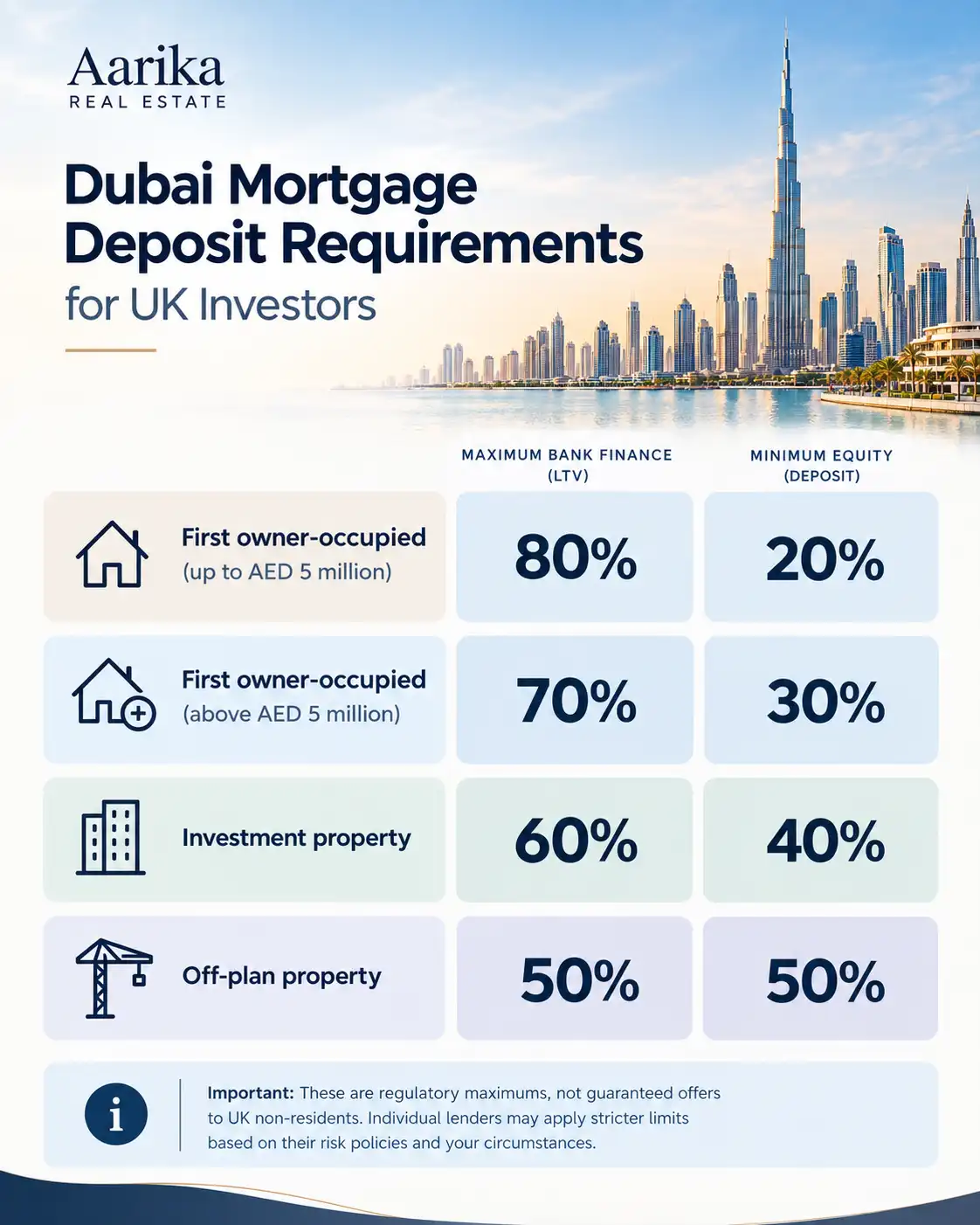
These are regulatory maximums, not guaranteed offers to UK non-residents. Banks can impose stricter limits based on their risk policies and your circumstances.
For example, FAB currently advertises up to 50% financing for non-UAE residents buying investment property.
So a UK investor should think about the deposit in terms of the specific lender and property, rather than simply assuming a 20% deposit will be enough.
What Are the Legal Requirements for Getting a Dubai Mortgage as a UK Investor?
Foreign buyers can purchase property in Dubai in designated ownership areas, and mortgage providers can finance qualifying residential property subject to their lending criteria.
The important distinction is between legal eligibility to own property and eligibility for a particular mortgage product.
You may be legally able to purchase a property but still not meet a particular lender's income, deposit, property, or residency requirements.
The UAE Central Bank requires lenders to assess repayment capacity, income, liabilities, LTV, and the property being offered as security. Lenders can also apply stricter requirements than the regulatory maximums.
For a UK investor, this is why mortgage pre-approval can be useful before committing to a property.
How Can a UK Investor Get a Mortgage in Dubai?
The process will vary between lenders, but the overall journey is relatively straightforward.
Paperwork and Documentation
Expect the lender to ask for evidence of your identity, income, financial position, and existing liabilities.

Depending on your circumstances, this may include:
The exact list can vary significantly between lenders and borrower profiles.
For example, non-resident programmes may require more extensive financial documentation than a standard UAE-resident application. Don't assume the document requirements will be identical to a UK mortgage application.
The Step-by-Step Process of Get a Mortgage in Dubai
A typical Dubai mortgage journey for a UK investor looks like this:
1. Establish your budget
Work out how much capital you can put towards the purchase and how much you would potentially need to finance. Remember that your deposit is not the only upfront cash requirement.
2. Check mortgage eligibility
Speak with a lender or qualified mortgage adviser to understand the products available to your circumstances.
3. Obtain mortgage pre-approval
A pre-approval gives you a clearer indication of the amount a lender may be prepared to finance, subject to the final application and property checks.
4. Select a suitable property
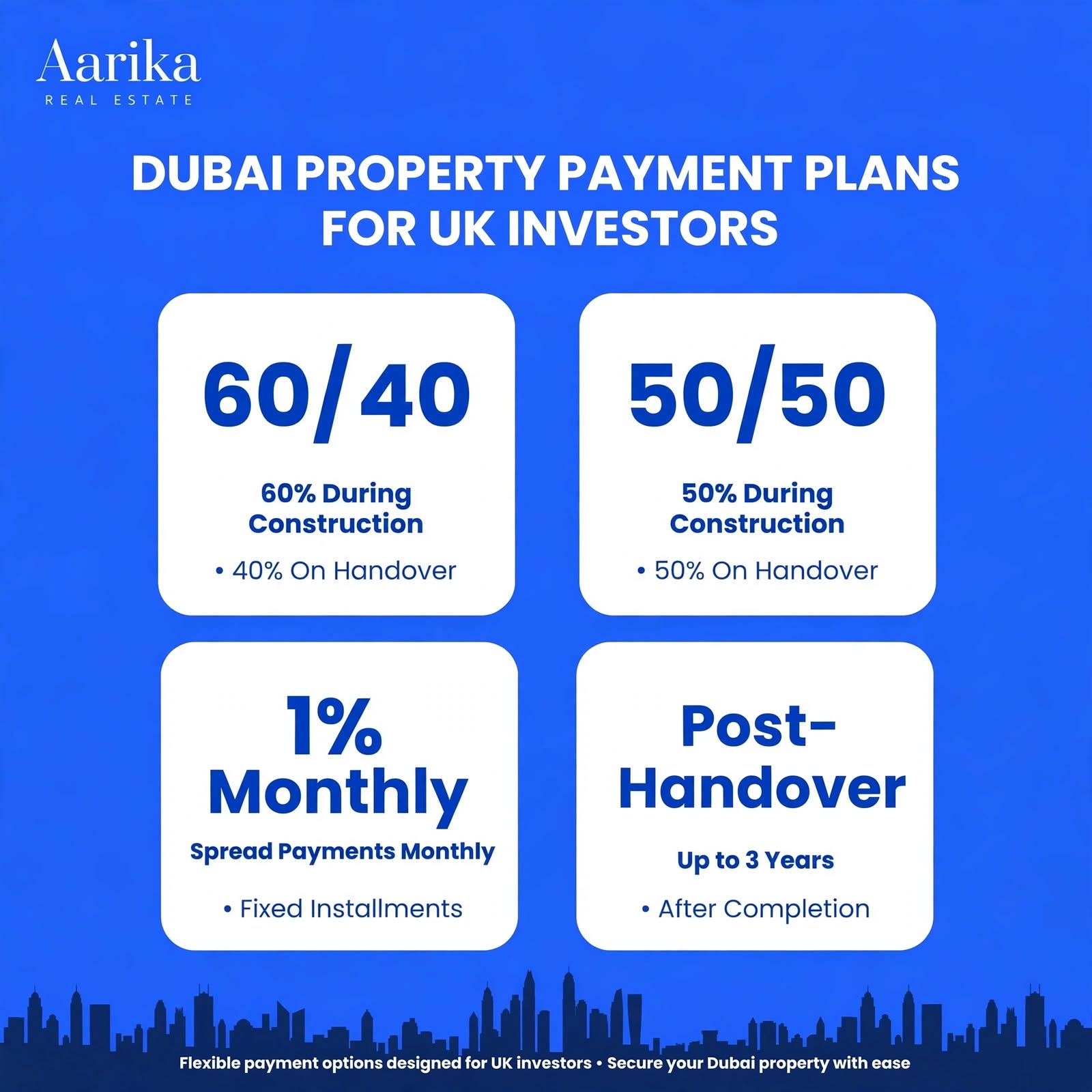
Once your financing range is clearer, compare properties based on location, price, property type, payment structure and investment objectives. You can also explore Dubai off-plan properties if you are considering a staged payment structure rather than conventional mortgage financing.
5. Property valuation and due diligence
The lender will normally require an independent valuation of the property before final approval. The Central Bank's framework requires lenders to use appropriate valuation and collateral-management processes.
6. Final mortgage approval
The lender reviews the borrower and property information before issuing the final facility documentation.
7. Completion and registration
Once the required conditions are satisfied, the purchase and mortgage are registered through the relevant Dubai property-registration process. Dubai Land Department currently lists mortgage registration at 0.25% of the mortgage value, alongside applicable title-deed and service-partner charges.
What Does a Dubai Mortgage Cost for UK Investors?
The mortgage interest or profit rate is only one part of the overall cost. A UK investor should also consider the purchase costs and mortgage-related charges.
Dubai Land Department currently publishes a 0.25% mortgage-registration fee based on mortgage value. It also lists additional issuance and service-partner charges.
Example: AED 2 Million Property
Let's say a UK investor purchases an AED 2 million ready property and obtains a mortgage of AED 1 million.
The illustrative structure would be:
- Property price: AED 2,000,000
- Mortgage: AED 1,000,000
- Investor's property equity: AED 1,000,000
- Mortgage registration at 0.25%: AED 2,500
This is not a complete calculation of the cash required to purchase the property.
The investor would still need to consider applicable purchase/registration costs, lender charges, valuation, insurance, and other transaction costs.
That's why looking only at the deposit can give a misleading picture of the capital required.
Planning to finance a Dubai property from the UK?
Compare suitable Dubai properties, payment plans and financing options based on your budget and investment goals.
What Are the Main Banks Offering Mortgages to Foreign Investors?
There isn't one lender that will be best for every UK investor.
The availability of non-resident finance and the terms offered can vary according to borrower profile, property and lender policy.
Examples of UAE lenders with published property-finance options include:
FAB currently publishes non-resident investment-property finance of up to 50% of property value. DIB separately markets a non-resident programme covering ready-property purchases and other home-finance options.
Emirates NBD currently advertises expatriate home loans with financing of up to 80% for qualifying customers, although the actual terms depend on eligibility, borrowing capacity and Central Bank requirements.
These published products should be treated as examples rather than a recommendation or guarantee of approval.
Should You Use a Dubai Mortgage Broker or Go Directly to a Bank?
Both approaches can make sense.

Going directly to a bank
This may suit you if:
Using a mortgage adviser or broker
This may be useful if:
The important point is to compare the whole financing package, rather than choosing a lender simply because it advertises the lowest headline rate.
Look at:
Ready vs Off-Plan: Which Is Easier to Finance?
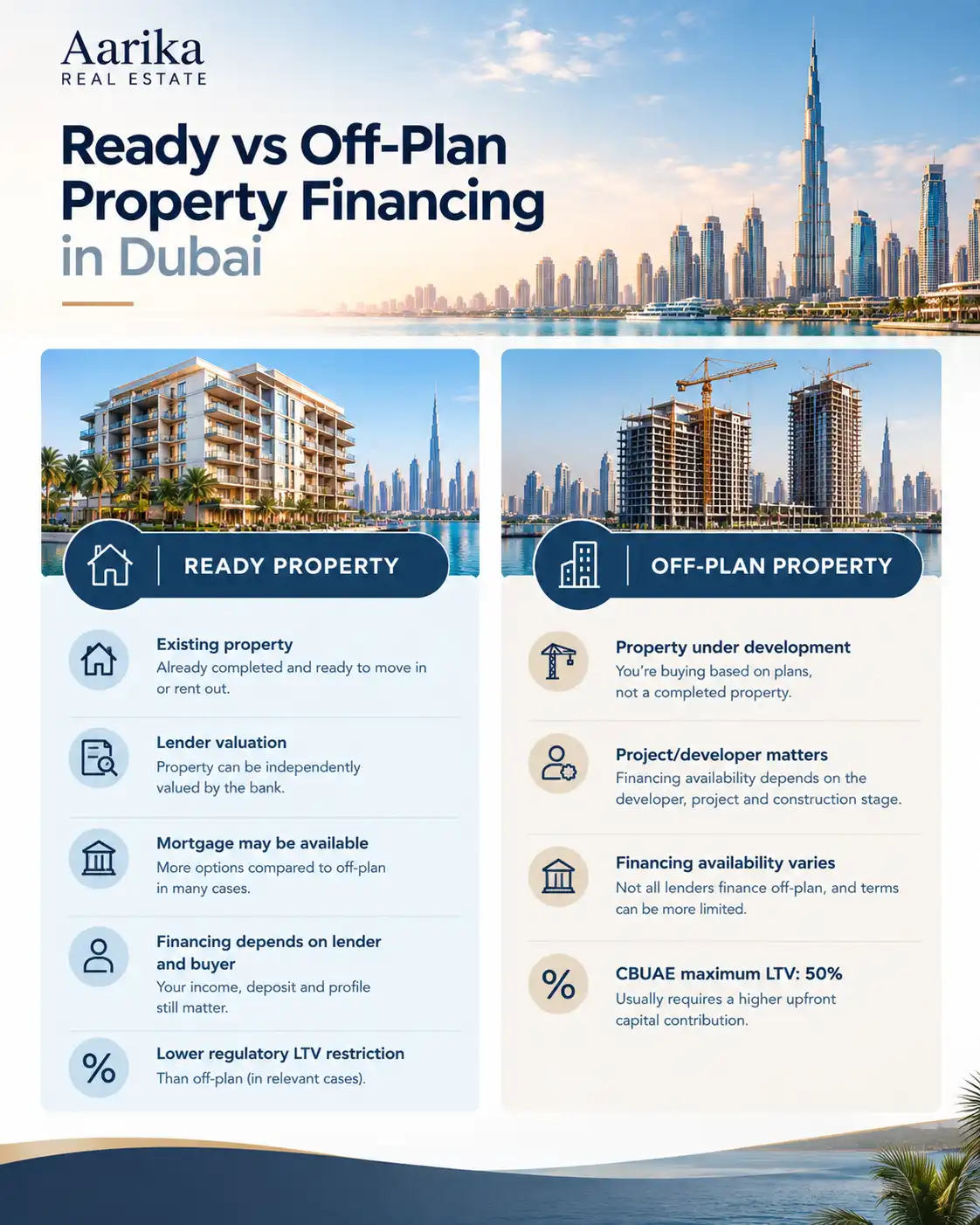
This is particularly important for UK investors considering Dubai's off-plan market. The Central Bank sets a maximum 50% LTV for off-plan purchases, regardless of purpose, property value, or purchaser category.
Can You Buy Dubai Property From the UK Without Visiting
That means financing an off-plan purchase can require substantially more upfront capital than some ready-property mortgage structures.
However, don't automatically assume that every off-plan property will be treated identically by every lender.
The availability of financing can depend on:
If you're comparing these two strategies, our guide to buying off-plan property in Dubai from the UK can help you assess the wider considerations.
Dubai Mortgage vs Cash Purchase vs Developer Payment Plan
A mortgage isn't automatically the best financing route.
UK investors can compare three broad approaches:
The right choice depends on your:
- Available capital
- Investment timeframe
- Income
- Risk tolerance
- Rental strategy
- Liquidity requirements
- Property type
- Exit strategy
For an investment property, don't judge financing purely by the size of the deposit. Consider total borrowing cost, expected rental income, service charges, vacancy, management costs, and your exit plan.
Our net rental yield guide can help you assess the income side of the equation.
How Much Can a UK Investor Borrow?
There isn't a single borrowing figure that applies to every UK investor.
The Central Bank's mortgage framework sets maximum LTV and DBR limits, while individual lenders assess affordability and can apply stricter criteria.
The maximum DBR is generally 50% of gross salary and regular income from defined sources. The Central Bank also requires lenders to stress-test mortgage affordability and, for investment property, account for potential rental vacancies when assessing repayment capacity.
This means a lender won't simply look at the property's value.
Your:
- Income
- Existing debts
- Monthly commitments
- Credit profile
- Deposit
- Property value
- Rental income
- Age and loan term
can all influence the amount you can borrow.
Can You Buy Dubai Property From the UK Without Visiting?
Potentially, yes.
The exact process depends on the property, developer, transaction structure, financing, and documentation.
A remote purchase may involve:
Dubai Land Department's mortgage-registration process specifically provides for non-resident foreigners using a valid passport and allows representation through a legal power of attorney where applicable.
For UK investors buying remotely, the key is not simply avoiding travel. It is making sure verification, documentation, payments, and registration are handled correctly.
Frequently Asked Questions About Dubai Mortgages for UK Investors
1. Can a UK citizen get a mortgage in Dubai?
Yes. Some UAE lenders offer mortgage or home-finance products to eligible foreign and non-resident buyers. However, the available products, deposit requirements, and approval criteria vary between lenders.
2. How much deposit does a UK investor need for a Dubai property?
It depends on the property, borrower, and lender. The CBUAE framework allows up to 60% LTV for second/subsequent or investment property and 50% LTV for off-plan property, while individual lenders may impose stricter limits.
3. Can non-residents get a Dubai mortgage?
Yes, some lenders offer dedicated non-resident programmes. FAB and Dubai Islamic Bank, for example, currently publish non-resident property-finance options.
4. What documents do UK investors need?
Typically, lenders may request identification, proof of income, bank statements, tax documentation, credit information, and evidence of existing liabilities. Self-employed applicants may need additional company and financial documents.
5. Can I get a mortgage for an off-plan Dubai property?
Off-plan finance is more restricted. The CBUAE framework sets a maximum 50% LTV for off-plan purchases, but actual availability depends on the lender, project, and borrower.
6. How much does Dubai mortgage registration cost?
Dubai Land Department currently lists mortgage registration at 0.25% of the mortgage value, with additional applicable registration and service charges.
7. Do UK investors need to consider UK tax?
Yes. UK tax residents generally need to consider UK tax treatment of foreign income, including rental income from overseas property. The exact treatment depends on individual circumstances.
Ready to explore Dubai property from the UK?
Get personalised guidance on suitable locations, property types, mortgage options and payment plans, based on your investment goals and budget.
Glossary of Dubai Mortgage Terms
If you're comparing Dubai mortgages from the UK, these are some of the terms you're likely to encounter.
- LTV (Loan-to-Value): The mortgage amount expressed as a percentage of the property's value.
- DBR (Debt Burden Ratio): The proportion of gross income used to service debt. The UAE Central Bank's maximum is generally 50%.
- Down payment: The portion of the property purchase price paid from your own funds rather than through the mortgage.
- Equity: The value of the property less the outstanding claims or mortgage secured against it.
- EIBOR: Emirates Interbank Offered Rate, a benchmark used in pricing some UAE variable-rate loans.
- Mortgage tenor: The length of time over which the mortgage is scheduled to be repaid.
- Fixed rate: A mortgage rate that remains fixed for an agreed period.
- Variable rate: A rate that can change according to the applicable pricing mechanism.
- Pre-approval: An initial indication from a lender of the financing you may qualify for, subject to final checks and property approval.
- Valuation: An independent assessment of the property's value used by the lender when considering the mortgage.
- Oqood: Dubai's provisional registration system for certain off-plan property transactions.
- Early settlement: Repaying some or all of the outstanding mortgage before the scheduled end of the loan.