
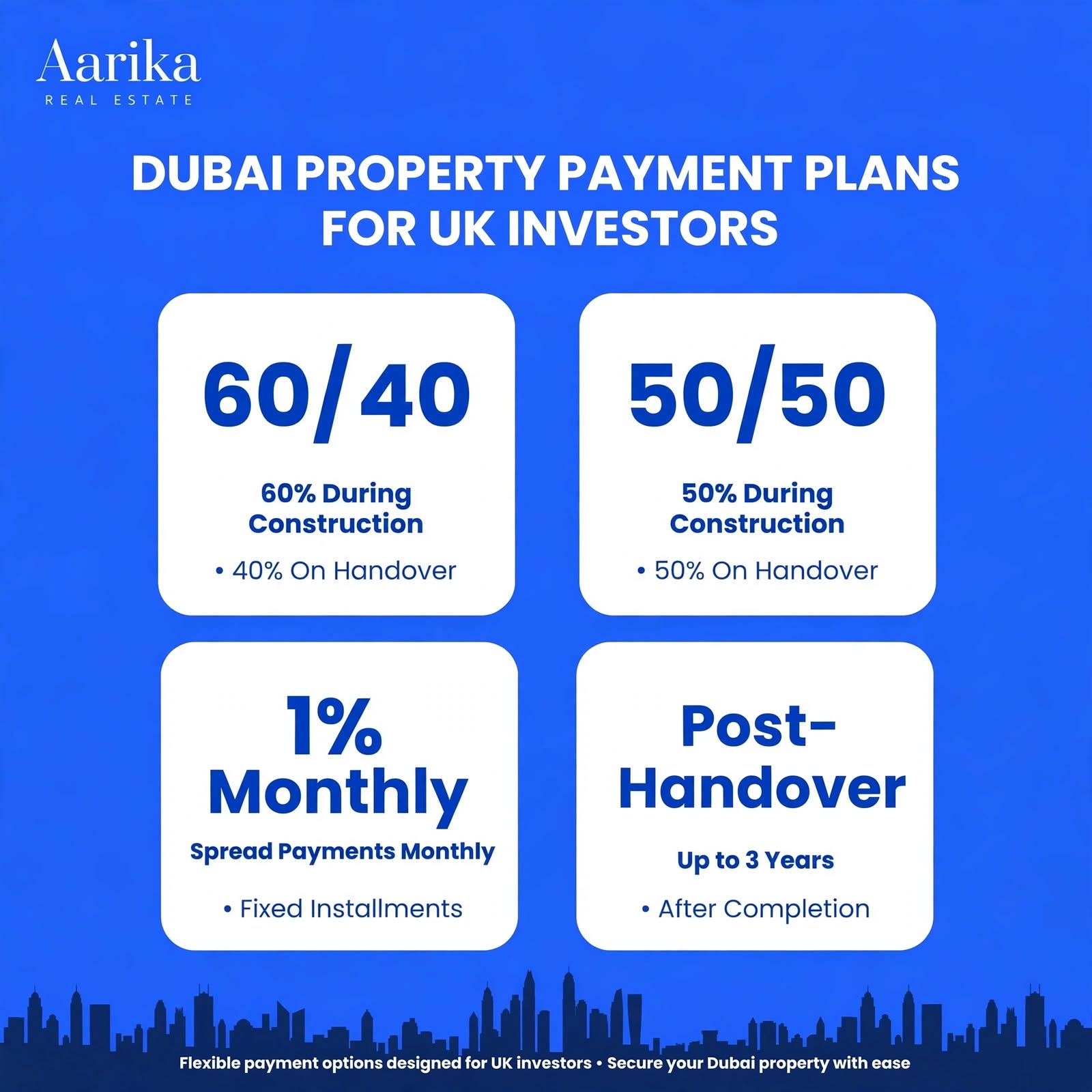
Dubai off-plan property is often marketed around the payment plan as much as the property itself. For UK investors, structures such as 60/40, 70/30, 50/50, 1% monthly and post-handover plans can change how much capital is required upfront and when future payments become due.
But the percentage alone does not tell you whether a payment plan is suitable.
A 60/40 structure requires more capital earlier but reduces the final payment. A post-handover plan can spread part of the remaining balance beyond completion, but the exact terms and costs depend on the project and developer.
For UK investors, the important question is therefore not simply “Which payment plan is best?” but “Which payment schedule works with my available capital, investment strategy and ability to fund future payments?”
If you're still assessing the broader buying process, our Dubai Buying Guide provides the wider framework, while this guide focuses specifically on how Dubai property payment plans work. and if you are investing in Dubai property from the UK, this guide focuses specifically on how Dubai property payment plans work and which structure fits your capital timeline.
What Types of Dubai Payment Plans Are Available for UK Buyers?
Dubai developers use a range of payment structures for off-plan properties. The exact percentages, instalment dates, and payment triggers vary by project, so the figures below should be treated as common structures rather than standard terms applying to every development.
The exact schedule depends on the developer and project.

The terminology can also be slightly misleading. For example, a “60/40” plan does not necessarily mean two payments of 60% and 40%. The 60% may be divided across a booking payment and several construction-linked instalments before the remaining 40% becomes payable at handover.
That is why UK investors should always request the full payment schedule, rather than assessing a project from the headline percentage alone.
How Do Dubai Property Payment Plans Work for UK Investors?
A Dubai off-plan payment plan is essentially a schedule specifying how much you pay and when you pay it.
The schedule is generally documented as part of the purchase agreement and can include:
Dubai Land Department's escrow framework is particularly relevant to off-plan purchases. DLD states that amounts collected from purchasers for off-plan units are deposited into the project's real estate escrow account, with the escrow system intended to regulate the construction process and protect purchasers' interests.
The practical point for a buyer is that the payment plan should be considered alongside the project registration, SPA, escrow arrangements, and developer documentation.
If you are unfamiliar with the wider off-plan process, our guide to buying off-plan property in Dubai covers the broader purchase process, while this article concentrates on the payment schedule itself.

60/40 Dubai Payment Plan
A 60/40 payment plan generally means 60% is paid during construction and 40% at handover.
This shifts more of the funding requirement into the construction period compared with another plan, but leaves a smaller balance for completion.
Current Dubai property guides commonly describe 60/40 as one of the standard construction-to-handover structures, although the precise instalment dates can vary by developer and project.
For a UK investor, the main question is therefore whether they prefer to:
commit more capital before completion in exchange for a smaller handover balance, or preserve more capital during construction while accepting a larger future payment.
Other Common Dubai Payment Plans
Not every project uses the same structure. Other payment plans you may encounter include the following.
70/30 Payment Plan
A 70/30 structure generally means:
- 70% during construction
- 30% at handover
Compared with others, substantially more capital is committed before completion, but the final balance is considerably smaller.
This can be relevant for investors who already have significant capital available and want to reduce their exposure to a large handover payment.
40/60 Payment Plan
A 40/60 structure generally means:
- 40% during construction
- 60% at handover
It therefore creates the opposite cash-flow profile to a 60/40 plan.
The lower construction-stage commitment may be attractive, but the investor needs a credible strategy for funding the larger completion balance.
50/50 Payment Plan
A 50/50 plan divides the purchase price relatively evenly:
- 50% during construction
- 50% at handover
Its main advantage is simplicity. Neither stage carries an extremely low or extremely high percentage compared with the more heavily front-loaded or back-loaded structures.
However, “balanced” does not automatically mean low risk. A £200,000 investor, for example, still needs to assess whether the future AED-denominated obligations fit their capital position.
80/20 Payment Plan
An 80/20 structure generally means:
- 80% during construction
- 20% at handover
This reduces the final payment substantially, but requires much greater capital commitment before the property is completed.
It may therefore appeal more to an investor with significant capital available during the construction period.
10/90 Payment Plan
A 10/90 structure generally implies a relatively small initial or construction-stage contribution followed by a much larger later payment.
However, the exact meaning of the 10% and 90% should never be assumed from the headline alone.
A developer may divide the initial percentage across booking and further instalments, while the later balance may have its own timing conditions.
For this type of plan, request the full schedule in writing and calculate the actual amount payable at each stage.
At a glance, for example: consider a Dubai property priced at AED 2 million
1% Monthly Dubai Payment Plans
The term “1% monthly” generally refers to a structure where the buyer pays approximately 1% of the purchase price per month under the applicable developer schedule.
For an AED 1 million property, 1% represents:
AED 10,000 per 1% instalment.
But this should not be interpreted as meaning every 1% monthly plan works identically.
Some developer structures can include a booking payment, monthly instalments, construction payments and a remaining balance. The full schedule therefore matters more than the marketing label.
Why might UK investors consider a 1% monthly plan?
Potential advantages include:
- Smaller recurring payments
- More predictable cash-flow planning
- Reduced need for one very large payment at a single stage
- Potentially easier budgeting for investors with regular income
What are the trade-offs?
The investor should check:
- How long the monthly payments continue
- What percentage remains after the monthly instalments
- Whether payments continue after handover
- The total purchase price compared with alternative payment structures
- Any additional costs outside the payment plan
A low monthly instalment does not automatically mean a lower overall cost.

Post-Handover Payment Plans
A post-handover payment plan allows part of the purchase price to remain payable after the property has been completed and handed over.
This can change the investment cash-flow profile significantly.
Instead of:
Construction payments → large handover payment → fully paid
the structure may look more like:
Construction payments → handover → continued instalments
The precise post-handover period and percentage vary considerably by project.
Some current market guides describe post-handover periods ranging from roughly one to several years on selected projects, but these are not universal Dubai terms.
Why can this appeal to UK investors?
The investor may receive the completed property while part of the purchase price remains outstanding.
That can be relevant to an investor who wants to preserve capital for other investments or expects the completed property to generate rental income.
However, rental income should not be treated as guaranteed funding for future instalments.
The property could experience:
The payment obligation continues according to the contractual schedule regardless of whether the property is rented.
For UK investors considering the rental side of the strategy, our guide on how to calculate net rental yield in Dubai is useful because gross rent alone does not show the amount actually available after relevant property costs.
Additional: Flexible Payment Options with Aarika
At Aarika Real Estate, we understand that every UK investor has different financial circumstances, purchasing power, and investment goals. Our team helps you explore available Dubai property payment plans and identify options that align with your budget and preferred payment schedule.
While developers set the original payment structures, there may be opportunities to discuss adjustments to instalment schedules, subject to developer approval. Aarika can also guide you through potential mortgage options and connect you with relevant financing providers where appropriate.
The goal is not to replace the developer's payment plan entirely, but to help you find a practical way to manage your purchase within the available terms and financing options.
Compare Dubai Properties and Payment Plans
Aarika can help you compare suitable Dubai properties, payment schedules, developers, and handover timelines before you commit.
Which Payment Plan Is Suitable for UK Investors Wanting Rental Income?
Rental-focused investors need to think about when the property can actually generate income.
An off-plan property under construction generally cannot generate normal rental income for the investor before handover.
This creates an important distinction:
Construction-stage payments
The investor is funding the purchase without rental income from the property.
Handover
The property becomes available for occupation or leasing, subject to completion and relevant requirements.
Post-handover payments
The investor may now have rental income available, but that income is not guaranteed to cover the outstanding instalments.
This is why a post-handover plan can look attractive to a rental-focused investor, but it should be assessed using net rental income rather than headline rent.
The investor should also account for vacancy, service charges, management and maintenance before assuming that rental income can support future payments.
For UK investors comparing Dubai and UK property strategies, our Dubai vs UK Property Investment guide provides the broader investment comparison; the payment plan itself should then be assessed separately.
Tips to Avoid Hidden Costs in Dubai Payment Plans
The payment-plan percentage is only one part of the total cost of buying property.
Before committing, ask for a complete breakdown of:
- Purchase price
- Booking amount
- Every scheduled instalment
- Handover payment
- Post-handover balance, if applicable
- Property registration costs
- Developer or administrative charges, where applicable
- Service charges after handover
- Financing costs
- Currency conversion and transfer costs
- Property management costs
- Any late-payment provisions
That distinction becomes particularly important when comparing payment plans with different timelines.
For the wider cost picture, see our guide to the true cost of buying property in Dubai.
Can a UK Investor Exit a Dubai Payment Plan Early?
Possibly, but this should never be assumed to be automatic.
An investor considering an early exit may need to examine:
- Whether the unit can be resold before completion
- Whether assignment is permitted
- How much of the purchase price has already been paid
- Whether the developer has specific conditions
- Whether any approval is required
- What happens to outstanding instalments
- Whether administrative or other charges apply
The answer can vary between projects and contracts.
If you're considering an off-plan purchase partly because you may want to sell before completion, review the relevant contractual terms before buying rather than assuming that a payment plan automatically gives you flexibility to exit.
Our guide on selling an off-plan property in Dubai before completion covers the broader resale considerations.
How Aarika Helps UK Investors Compare Payment Plans
At Aarika Real Estate, the objective is not simply to identify a property with the smallest initial payment.
We help UK investors compare suitable Dubai properties based on:
That means comparing the property and payment structure together.
Ready to Compare Dubai Payment Plans?
We can help you compare available properties and payment structures based on your budget and investment objectives.
Frequently Asked Questions
1. What is the most common Dubai property payment plan?
There is no single payment plan that applies to every Dubai development. Common structures include 40/60, 50/50, 60/40, 70/30 and 80/20, alongside 1% monthly and post-handover structures on selected projects. The exact schedule depends on the developer and project.
2. What is a 1% monthly payment plan in Dubai?
A 1% monthly plan generally refers to recurring instalments equivalent to around 1% of the purchase price, although the actual structure varies by developer. Buyers should review the complete payment schedule rather than relying on the “1%” headline.
3. What does post-handover payment mean?
A post-handover payment plan allows part of the purchase price to remain payable after the property has been completed and handed over. The remaining amount and repayment period vary by project.
4. Can UK investors buy Dubai property using an instalment plan?
Yes, UK investors can purchase eligible Dubai property using developer payment structures where the project offers them. The exact payment terms depend on the property, developer, and contractual agreement.
5. Are Dubai developer payment plans available for every property?
No. Payment plans are project-specific. Ready properties and off-plan properties can have very different payment structures, and even off-plan projects from the same developer may use different schedules.
6. Can you sell a Dubai property before completing the payment plan?
Potentially, but this depends on the project's contractual terms, developer requirements, and applicable regulations. Buyers should check assignment and resale conditions before purchasing if an early exit is part of their strategy.
7. What happens if you cannot make a scheduled payment?
The consequences depend on the contractual terms and applicable rules. Buyers should understand the payment default provisions in the SPA and seek appropriate professional advice before signing.
8. Can rental income fund a post-handover payment plan?
Rental income may contribute towards the ongoing cost, but it should not be treated as guaranteed. Vacancy, service charges, management costs, maintenance, and changes in rental income can affect the amount available to meet future instalments.