

A Dubai holiday home may generate more rental revenue than a long-term let, but higher income does not always mean higher profit.
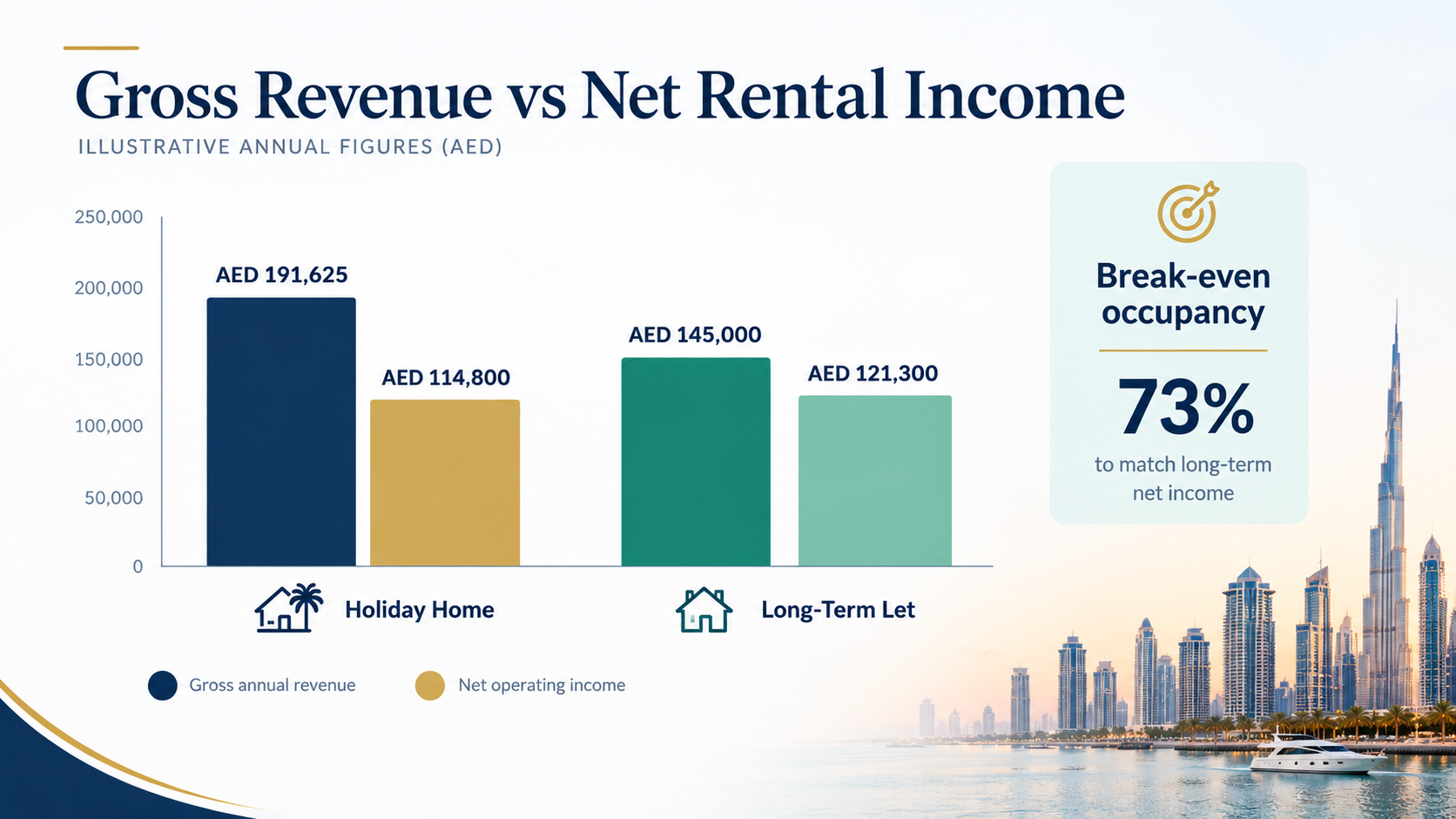
Consider two identical AED 2 million apartments. In an illustrative scenario, the holiday home generates AED 191,625 in annual revenue, compared with AED 145,000 from a long-term tenancy. Yet after operating expenses, the long-term let produces slightly more net income.
For UK landlords, this difference matters. Choosing between Dubai holiday homes and long-term rentals involves more than comparing nightly rates. Occupancy, management fees, UK tax obligations and remote ownership all affect the investment decision.
If you're considering purchasing your first Dubai rental property, our invest in Dubai from the UK guide explains the wider investment process.
Dubai Holiday Home vs Long-Term Let: Quick Comparison
Both strategies can generate rental income, but their financial and operational requirements differ.
The key difference is income predictability versus potential upside. Holiday homes may generate more gross revenue, but long-term lets can retain more income after expenses.
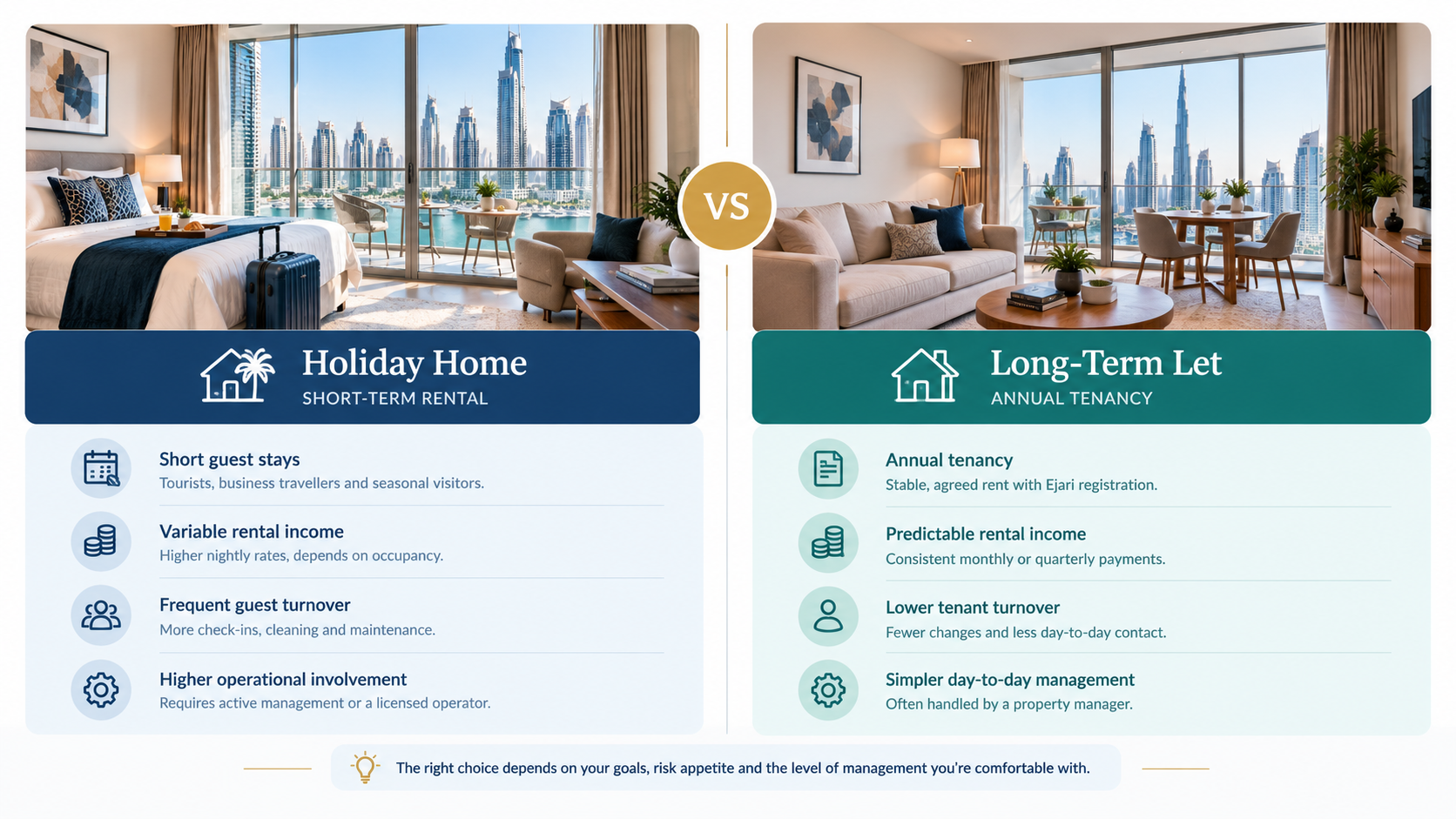
For UK landlords, the better choice depends on net profit, management requirements and the level of risk they are comfortable accepting.
How Do Holiday Homes and Long-Term Lets Work in Dubai?
Dubai Holiday Homes: Short-Term Rentals
A Dubai holiday home is a furnished property offered for temporary stays to tourists, business travellers and other short-term guests.
Properties may be marketed through platforms such as Airbnb and Booking.com or managed by a licensed holiday-home operator.
Owners or their operators handle guest bookings, cleaning, check-ins, maintenance and pricing.
Dubai holiday homes must comply with the Department of Economy and Tourism (DET) holiday-home framework. Before accepting guests, owners or authorised operators must ensure the property has the required registration and permit.
UK investors should also check the property's contractual restrictions, building rules, and eligibility for holiday-home use before purchasing. Not every residential unit is automatically suitable for short-term letting.
For official requirements, see the Dubai Department of Economy and Tourism's Holiday Homes guidance.
Dubai Long-Term Lets
A long-term let involves renting a property to a tenant under an agreed tenancy contract, commonly for 12 months.
Long-term tenancy contracts are registered through Ejari, Dubai's tenancy-registration system administered by the Dubai Land Department (DLD). Registration formalises the tenancy record and supports access to relevant rental services.
UK landlords should confirm the registration process, tenancy terms, and management responsibilities before letting their property.
See the Dubai Land Department's official website for Ejari services and guidance.
Rent is agreed under the contract, while responsibilities for utilities, maintenance, and other expenses depend on the tenancy terms and applicable regulations.
For UK investors who prefer limited day-to-day involvement, a long-term let may be easier to manage remotely.
Which Offers Better Rental Yields: Holiday Homes or Long-Term Lets?
Higher rental revenue does not always translate into higher investment returns.
A holiday home may command attractive nightly rates during peak travel periods, but earnings fluctuate with occupancy and seasonality. Long-term rentals usually provide a more consistent contractual income stream.
Gross Rental Income vs Net Rental Yield
Gross rental income is the total rent or booking revenue received before expenses. Net rental income is what remains after relevant operating expenses.
For example, a holiday home generating AED 180,000 annually may appear more profitable than a long-term let earning AED 140,000. However, if the holiday home's operating expenses are substantially higher, the difference in actual profit could be small or even favour the long-term rental.
A simple net rental yield calculation is:
This simplified formula excludes financing costs, acquisition costs, and personal taxation.
Why Occupancy Matters
Holiday-home income depends on two variables:
A property advertised at AED 700 per night will not generate AED 255,500 annually unless it is occupied every night.
At 60% occupancy, its approximate gross annual revenue would instead be AED 153,300.
UK investors should therefore compare realistic occupancy assumptions rather than maximum potential nightly income.
Use our Dubai property ROI calculator to assess projected rental returns before choosing an investment property.
Holiday Home vs Long-Term Let: Example Cost and Profit Comparison
Consider two identical Dubai apartments, each purchased for AED 2 million. One is operated as a holiday home, while the other is rented to a long-term tenant.
The following example uses hypothetical income and expense assumptions to illustrate how the strategies can compare.
Illustrative example only. Figures are not verified market averages or actual property offers. They exclude booking-platform charges, furnishing and replacement costs, financing, acquisition costs, personal taxation, and other project-specific expenses. Actual owner and tenant obligations vary.
What Does This Comparison Reveal?
Despite generating AED 46,625 more gross revenue, the holiday home produces AED 6,500 less annual net operating income in this scenario.
The reason is straightforward: its higher management and operating expenses absorb the additional revenue.
This does not mean long-term lets always outperform holiday homes. It shows why UK landlords should compare net income rather than advertised nightly rates.
What Costs Are Not Included in This Example?
The comparison focuses on annual operating income, but actual investment returns depend on additional property-specific expenses.
Holiday-home owners may need to budget for booking-platform commissions, initial furnishing, furniture replacement, linen, repairs, and other guest-related costs. Long-term landlords may face tenant-finding fees, vacancy between tenancies, and maintenance expenses.
Both strategies can also involve property acquisition costs, service charges, financing expenses, and UK tax considerations.
These costs should be assessed separately before treating the illustrative net rental yields as achievable investment returns.
For official information about Dubai property registration and related services, consult the Dubai Land Department.
At What Occupancy Does the Holiday Home Become More Profitable?
Using the same example, and assuming the stated holiday-home costs remain fixed except for the 20% management fee, the holiday home would need approximately 73% occupancy to match the long-term rental's net operating income.
That is the break-even occupancy under these assumptions, not a forecast of achievable bookings.
Holiday Home or Long-Term Let: Which Fits Your Budget?
Compare Dubai rental opportunities, projected expenses, and investment goals with a property advisor.
What UK Landlords Need to Know About Dubai Rental Income Tax
Dubai's personal tax environment can appeal to overseas property investors, but UK landlords should not assume their Dubai rental income is free from UK taxation.
UK Tax on Dubai Rental Income
UK tax residents are generally liable to UK tax on overseas rental profits, including income from Dubai holiday homes and long-term lets, subject to applicable exemptions and reliefs.
According to HMRC's guidance on foreign income, foreign property rental income may need to be reported through Self Assessment.
HMRC generally treats rental profits from properties outside the UK as part of an overseas property business, with specific rules governing deductible expenses and losses.
The UK's four-year Foreign Income and Gains (FIG) regime may provide relief to qualifying new UK residents who meet the eligibility requirements, including the relevant period of prior non-UK residence. It is not a general exemption for all British landlords.
Three Tax Checks for UK-Based Landlords
Before comparing after-tax rental returns, UK investors should consider:
- UK tax residence: Whether they are UK tax residents for the relevant tax year.
- Allowable expenses: Which property-related costs may be deductible under UK tax rules.
- Income reporting: How overseas rental profits, relevant expenses and any applicable reliefs should be reported to HMRC.
Currency Exchange and Reporting
Dubai rental income is generally received in UAE dirhams, while UK tax reporting and personal investment returns are often assessed in pounds sterling.
Changes in the GBP/AED exchange rate can affect the sterling value of rental income, even when the property's income remains unchanged in AED.
UK landlords should assess expected net returns in both currencies and obtain qualified tax advice before making an investment decision.
Can UK Owners Manage Dubai Holiday Homes Remotely?
Yes. UK-based owners can arrange for Dubai rental properties to be managed locally, although the level of involvement differs between the two strategies.
Managing a Holiday Home From the UK
A holiday-home management company may handle guest communications, pricing, check-ins, cleaning, maintenance and booking administration.
This reduces the owner's operational workload, but management fees and other operating expenses affect profitability.
Before appointing an operator, UK landlords should confirm what the management fee includes and whether cleaning, marketing, booking-platform charges and maintenance are billed separately.
Managing a Long-Term Tenant From the UK
A long-term property manager can assist with tenant sourcing, rent collection, maintenance coordination, and tenancy renewals.
Because tenant turnover is generally less frequent, long-term rentals may require less ongoing operational involvement.
However, owners still need to budget for maintenance, vacancy periods, and management responsibilities.
If you are purchasing remotely, our buying property in Dubai from the UK guide covers the wider process for overseas buyers.
Best Dubai Areas for Holiday Homes vs Long-Term Rentals
Location can influence both rental demand and operating costs. A property that attracts short-stay visitors may not necessarily deliver the strongest long-term rental return.
Dubai Marina
Dubai Marina offers waterfront attractions, restaurants, transport connections and established residential developments.
UK investors can compare potential short-stay visitor demand with the area's long-term residential tenant market.
Downtown Dubai
Downtown Dubai attracts visitors interested in major attractions, shopping and business access.
However, purchase prices, building service charges and operating costs should be considered alongside potential nightly rates.
Palm Jumeirah
Palm Jumeirah offers premium waterfront properties that may appeal to higher-budget holiday guests.
The investment case depends on acquisition cost, property type, guest demand, and the expense of operating and maintaining the property.
There is no universally best location for either rental strategy. Compare similar properties within the same building or neighbourhood whenever possible, rather than relying on area-wide averages alone.
Which Rental Strategy Is Better for Your Investment Goals?
The right rental model depends on what you expect from the property.
Choose a Holiday Home If…
You are comfortable with fluctuating rental income, want flexibility between bookings, and are willing to pay for active property management.
The property should also have a credible short-stay demand profile and a realistic opportunity to earn enough additional revenue to cover higher expenses.
Choose a Long-Term Let If…
You prefer more predictable rental income, fewer tenant changes and a comparatively straightforward ownership arrangement.
A long-term let may also suit UK investors who want to minimise operational involvement while holding a Dubai property for several years.
Before purchasing, you can explore available off-plan properties in Dubai and assess which developments may suit your intended rental strategy after completion.
Risks UK Landlords Should Consider Before Choosing
Holiday-home risks include seasonal booking fluctuations, lower-than-expected occupancy, frequent guest turnover, furnishing replacement costs and dependence on property-management performance.
Long-term rental risks include tenant arrears, vacancy between tenancies, unexpected maintenance expenses and limitations arising from existing tenancy agreements.
UK-based owners should also consider GBP/AED currency movements, property value fluctuations and changes to applicable rental regulations.
A practical way to assess risk is to stress-test the investment. For example, calculate holiday-home returns at 50%, 60% and 70% occupancy, then compare them with a long-term rental scenario that includes a vacancy period and maintenance allowance.
A rental strategy should remain financially manageable even when actual income falls below the original projection.
FAQs: Dubai Holiday Homes vs Long-Term Lets for UK Landlords
1. Is Airbnb more profitable than long-term renting in Dubai?
It can be, but profitability depends on nightly rates, occupancy, management fees, and operating costs. A holiday home with higher gross revenue may still produce lower net income than a long-term rental.
2. Can UK residents legally operate a holiday home in Dubai?
UK nationals can own eligible properties in Dubai and arrange holiday-home operations, subject to applicable ownership rules, property restrictions and DET permit requirements. The property and operator must meet the relevant requirements.
3. Do UK landlords pay UK tax on Dubai rental income?
UK tax residents generally need to consider UK tax on foreign rental income. The final liability depends on residence status, allowable expenses, and applicable reliefs. Dubai's local personal tax environment does not remove UK reporting obligations.
4. Can I manage a Dubai rental property without living in the UAE?
Yes. Local property managers can handle guest services or long-term tenancy administration. UK owners should check the management agreement, costs, reporting arrangements, and responsibilities before appointing a provider.
5. Can I switch a Dubai property from a holiday home to a long-term let?
A change may be possible, but it depends on existing bookings or tenancy commitments, the property's contractual restrictions, and applicable registration or permit requirements. Owners should confirm these before changing rental use.
Final Takeaway: Holiday Home or Long-Term Let?
For UK landlords prioritising predictable income and simpler remote management, a long-term let may be the more suitable option.
A Dubai holiday home may be worth considering when the property has strong short-stay demand and the expected additional revenue is sufficient to cover higher operating expenses.
The deciding factor is not the rental model itself, but which strategy produces sustainable net returns for your specific property, budget and investment goals.
Before buying, compare both options using realistic income assumptions, property-specific costs and relevant UK tax considerations.
Which Dubai Rental Strategy Fits Your Goals?
Explore holiday home and long-term rental opportunities based on your budget, expected returns, and ownership preferences.