

Dubai has two property routes to residency: a 2-year investor visa that, since April 2026, has no minimum property value for sole owners, and a 10-year Golden Visa that requires AED 2 million of qualifying property. The price gap is only part of the difference. Property type, time spent abroad, and what the visa depends on matter as much. Decide what you want to buy and why first, then check which route that purchase supports.
What separates the two routes
The 2-year visa is the lower-cost entry. The Golden Visa is the longer, more flexible route, and it requires more capital.
Neither is a better visa in general. The right one depends on the property you are buying, how much of the year you will spend in the UAE, and whether you want residency for yourself or for your family.
How each route works
The 2-year property investor visa, and what changed in April 2026

This is the entry-level route, handled by the Dubai Land Department (DLD) through its Taskeen service and issued by the immigration authority, GDRFA. Until April 2026, it required a property worth at least AED 750,000. That floor has now been removed for sole owners, so a single owner can apply regardless of the property cost. Joint owners are different: each co-owner's share must still be worth at least AED 400,000.
The change appeared on the DLD-affiliated Cube platform without a formal announcement, so check DLD's current service page before you rely on it. It applies only to the 2-year route. The Golden Visa threshold did not move.
The application is built around a title deed or e-Certificate of Title, which is why in practice, the property needs to be completed and registered.
The 10-year property Golden Visa

The federal Golden Residency gives 10 years of residence without a local sponsor. For real estate, the investor must own one or more UAE properties worth at least AED 2 million in total, registered in their own name. A loan is acceptable if it comes from an approved local bank. Off-plan units can also count if their combined value reaches AED 2 million and they are bought from an approved local developer.
In Dubai, most buyers apply through a DLD service. That service states that the applicant must be inside the UAE. The federal guidance separately says eligible applicants who are abroad can get a six-month multiple-entry visa to complete the procedure. Either way, plan a trip to Dubai rather than expecting to finish it entirely from home.
Requirements side by side
Property value: one property or several
For the 2-year visa, one qualifying property in your sole name is enough, at any value. For the Golden Visa, the total value of your qualifying properties must reach AED 2 million, and several properties can be added together. DLD can assess value from its own certified valuation, so the original purchase price does not always decide the outcome.
Joint ownership
The 2-year visa requires each co-owner to hold a share worth at least AED 400,000. The Golden Visa is stricter: DLD describes the property as wholly owned by the applicant, so a co-owner's own share generally needs to reach AED 2 million. Two unrelated buyers cannot split one AED 2 million property and expect two Golden Visas. If you are buying with a spouse or partner, confirm how DLD will treat your specific ownership split before you sign.
Ready or off-plan
This is where the two routes diverge most for buyers who purchase before completion.
- 2-year visa: needs a title deed, so a unit still under construction does not qualify until the deed is issued.
- Golden Visa: off-plan units can count towards AED 2 million when bought from an approved developer. Confirm the project's eligibility before you commit, not after.
Mortgaged property
Both routes can work with a mortgage, but a bank no-objection letter is part of the file. For the Golden Visa, DLD asks for a letter that states the amount paid and the balance outstanding. Published guidance differs on whether DLD tests total property value or the amount you have actually paid, and the 2-year visa's paid-amount rule has been reported differently since April. Check the current test with DLD and your lender before relying on a mortgage-funded purchase for either route.
Documents you will be asked for
Exact lists change, so treat this as the outline rather than the checklist.
- Passport and a recent photograph
- Title deed or e-Certificate of Title
- A certificate of good conduct from Dubai Police, addressed to DLD (2-year visa)
- Valid health insurance (required for Golden Residency)
- Medical test and Emirates ID procedures once approved
- Bank letter and statement, if the property is mortgaged
Government fees apply to both routes. We have not listed figures here because they change; DLD's service pages show the current amounts.
What each route gives you, and where it stops
The 2-year property visa
- Lowest entry point. A sole owner of one completed property qualifies at any value.
- Family cover. Spouse and children can be sponsored under DLD rules; parents are covered for a shorter period.
- Limits. It must be renewed every two years; it depends on you keeping the qualifying property, and it is not a work permit. Time abroad needs watching: the standard rule cancels a residence visa after about six months outside the UAE, and published guidance differs on whether property investor visas are exempt. Until DLD or GDRFA confirms in writing, assume the six-month limit applies.
The 10-year property Golden Visa
- No sponsor and a longer horizon. Ten years of residence, renewable.
- Wider family cover. Spouse, children of any age, and parents.
- Flexibility. Holders can live, work, and study in the UAE, and Golden Visa holders are exempt from the six-month cancellation rule.
- Limits. It is tied to the property investment, so selling can affect renewal. It needs AED 2 million in qualifying property, and that capital is committed to Dubai real estate, with the price swings and liquidity that come with it.
Does buying property in Dubai give you citizenship?
No. Both routes are residence permits tied to your property. Neither leads to a UAE passport, and no amount of property purchased changes that. Searches for "citizenship by investment Dubai" usually mean one of these two visas, and it is worth being clear about the difference before you commit capital.
Which route fits which buyer
Find the row closest to your situation. This is a guide to what each route supports, not a recommendation to buy a particular property.
If the Golden Visa is the goal, buying at exactly AED 2 million leaves little margin for a valuation that comes in lower. If it is not the goal, there is no reason to stretch your budget to reach the threshold.
Visa first or property first? Questions to ask before you buy
A visa should come out of a sound purchase, not the other way round. A property that is poor value does not become a good investment because it qualifies for residency. Before you pick a route, work through these questions.
- Would I still buy this unit if there were no visa? If the answer is no, the visa is covering for a weak investment case.
- Will I live here, let it out, or hold it? Residency matters most if you will actually be in Dubai. If you are mainly an overseas landlord, the visa may be a minor part of the decision.
- When does it complete? The 2-year visa needs a title deed. If you are buying off-plan, the handover date sets when that route opens.
- What happens if I sell? Both visas depend on holding qualifying property. Think about your exit before you buy.
- Is the price right for my budget without the visa? Compare off-plan and ready property on cash flow and risk, and run through our due diligence checklist before you reserve a unit.
- Have I counted all the costs? Registration, service charges, financing, and visa fees add up. See the hidden costs of buying off-plan.
If you are still learning how the purchase works, start with our guide to buying property in Dubai as a foreigner.
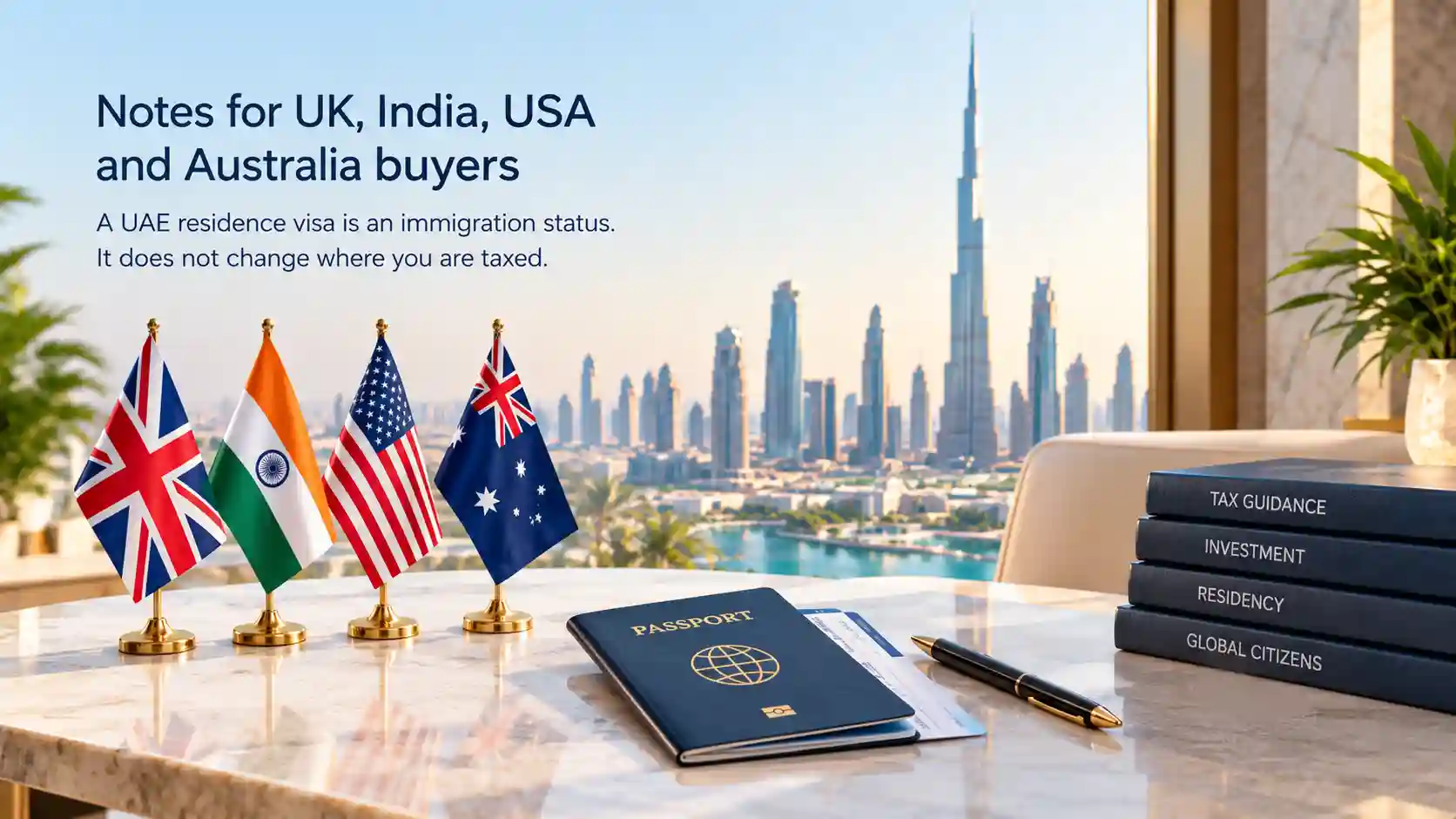
Notes for UK, India, USA and Australia buyers
A UAE residence visa is an immigration status. It does not change where you are taxed. Speak to a qualified tax adviser in your home country before you plan around either route.
- UK: UK tax residence is decided by the Statutory Residence Test, which looks at days spent in the UK and your ties to it, not at where you hold a visa. See our guides for UK investors and Dubai vs UK property investment.
- India: Funding the purchase from India runs through the Liberalised Remittance Scheme and its tax rules. Our guide to buying property in Dubai from India covers the remittance side, and the India investor page covers the wider process.
- USA: US citizens are generally taxed on worldwide income wherever they live, so a UAE visa does not change their US filing position. See the USA investor page.
- Australia: Australian tax residence follows Australian residency tests, not UAE visa status. See the Australia investor page.
Frequently asked questions
1. What is the main difference between the 2-year property visa and the Golden Visa?
Duration and cost of entry. The 2-year visa lasts two years and has no minimum property value for sole owners. The Golden Visa lasts ten years and requires AED 2 million in qualifying property. They also differ on off-plan eligibility, family cover, and rules on time spent abroad.
2. Do I still need AED 750,000 for the 2-year visa?
Not as a sole owner. Dubai removed that floor in April 2026. Joint owners still need a share worth at least AED 400,000 each.
3. How much property do I need for the Golden Visa?
Qualifying UAE property worth at least AED 2 million in total. One property or several can count, and approved off-plan units can count too.
4. Can a mortgaged property qualify?
Yes, for both routes, with a bank no-objection letter. How DLD tests the paid amount has been reported differently, so confirm it with DLD and your lender first.
5. Can I apply as a joint owner?
For the 2-year visa, yes, if your share is worth at least AED 400,000. For the Golden Visa, your own share generally needs to reach AED 2 million.
6. Can I upgrade from the 2-year visa to the Golden Visa later?
Only if you later own qualifying property that meets the Golden Visa test, for example, by adding another property to reach AED 2 million. It is a separate application, not an automatic upgrade.
7. Does either visa lead to UAE citizenship?
No. Both are residence permits tied to your property.
Check which route your shortlist supports
If you are comparing properties and want to know which of them would qualify for which route, send us your budget, whether you are buying ready or off-plan, and how you plan to use the property. We will check your shortlist against the current DLD requirements and tell you what each option does and does not support, before you reserve a unit.
For a deeper UK walkthrough of the Golden Visa itself, see Dubai Golden Visa for UK citizens.
Sources
- UAE ICP: Golden Residency Guide
- Dubai Land Department: Golden Visa application (Investor)
- Dubai Land Department: Investor Residence Application (Taskeen)
- KPMG: Dubai revises real estate investor visa rules (19 May 2026)
- Khaleej Times: Dubai updates two-year residency visa rule (29 April 2026)
- EY: UAE re-entry permit for residents abroad six months or more (February 2023)
- Takween Advisory: staying outside the UAE on an investor visa