

If you are an Indian resident investor, business owner, or HNWI looking to diversify your portfolio with Dubai off-plan real estate, our Invest in Dubai From India guide provides broader guidance for Indian investors, while this article focuses specifically on LRS, TCS, banking and cross-border payments.
RBI confirms that resident individuals can use LRS to purchase immovable property outside India. The current LRS limit is USD 250,000 per financial year. However, navigating annual transfer caps, the 20% Tax Collected at Source (TCS), bank compliance documentation, and developer escrow transfers requires structured execution.
RBI Liberalised Remittance Scheme (LRS) for Dubai Real Estate
Under the Foreign Exchange Management Act (FEMA) and RBI guidelines, Indian resident individuals can remit up to USD $250,000 per financial year (April 1 to March 31) for permissible capital account transactions, which explicitly includes purchasing overseas residential or commercial immovable property.
Before working through the payment and remittance structure, you should first understand the property purchase itself. Our guide to buying off-plan property in Dubai covers the key considerations around developers, payment structures, due diligence and the buying process.
How LRS Fits Off-Plan Payment Plans
Dubai off-plan developments typically operate on linked construction payment plans (e.g., 50/50, 60/40, or 70/30) distributed across 2 to 4 years. This structure works in favor of Indian investors:
Staggered Outflows: You do not need to transfer the full property value upfront. Installments are spread across multiple Indian financial years.
Staying Within Annual Caps: If the payment schedule spreads the investment across three or four financial years, an investor may use each year's available LRS limit toward the scheduled instalments, subject to the applicable RBI rules and any other LRS remittances made during those years.
Family Pooling Guidelines
RBI permits consolidation of family-member remittances subject to individual compliance. For capital-account transactions, RBI states that clubbing is not permitted where the contributing family members aren't co-owners/co-partners of the investment.
TCS on Outward Remittance: Rates, Mechanics, and Tax Credits
Under Section 206C(1G) of the Indian Income Tax Act, outward remittances under LRS for property investments are subject to Tax Collected at Source (TCS) levied by your Indian Authorized Dealer (AD Category-I) Bank.
TCS Is an Upfront Tax Collection, Not a Permanent Cost
TCS collected on an LRS remittance is generally available as a tax credit against the taxpayer's final Indian tax liability, subject to applicable rules. This means investors should treat TCS primarily as an upfront cash-flow requirement when planning their property payments.
- How It Works: TCS is an advance tax collected by your bank and deposited with the Income Tax Department against your PAN.
- Form 26AS & Form 27D: The bank issues a TCS certificate (Form 27D), and the collected amount reflects in your Form 26AS and AIS (Annual Information Statement).
- Claiming Credit: You can offset the entire TCS amount against your total Indian advance tax or self-assessment tax liability when filing your Income Tax Return (ITR). If the TCS collected exceeds your final tax liability, the excess may generally be claimed as a refund when you file your income tax return, subject to applicable tax rules.
Example Calculation:
If you remit ₹50,00,000 (approx. AED 220,000) for an off-plan milestone payment:
- Annual LRS threshold: TCS generally applies to the aggregate amount of LRS remittances exceeding ₹10 lakh during the financial year. The threshold is not a separate ₹10 lakh allowance for each property payment.
- Applicable Amount: ₹40,00,000 subject to 20% TCS = ₹8,00,000.
- Total Outflow at Bank: ₹58,00,000 (₹50 Lakh payment + ₹8 Lakh advance tax credit).
- Tax Adjustment: The ₹8,00,000 is credited in your ITR to reduce your tax bill or trigger a refund.
Step-by-Step Banking Flow: Transferring Funds to Dubai
To ensure smooth processing without delays or RBI compliance queries, follow this banking workflow as part of the wider buying property in Dubai process when remitting funds to a Dubai developer:
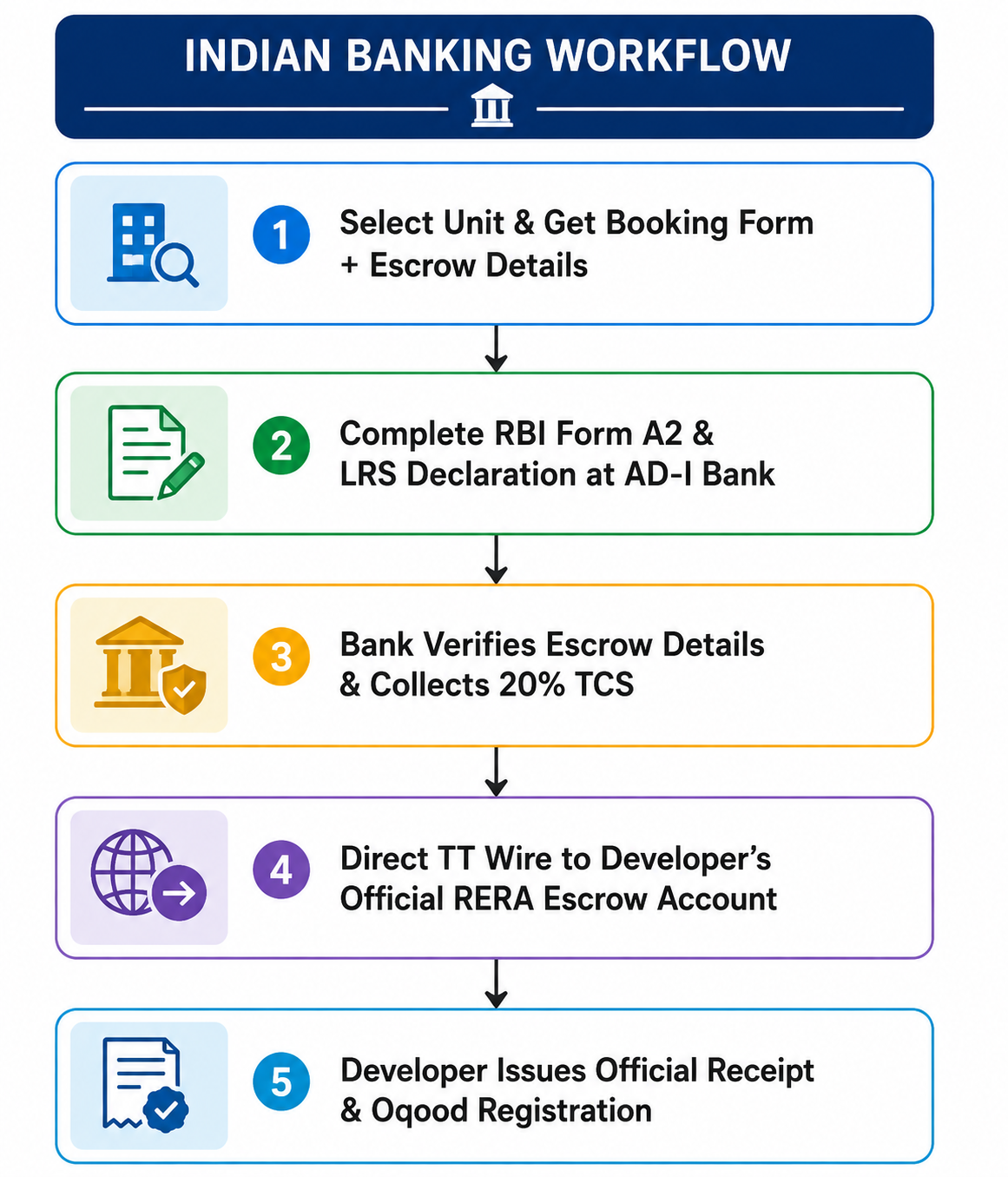
- Verify Developer Escrow Details: For an off-plan project, verify that purchase payments are being directed to the project's official escrow account. Dubai Land Department states that amounts collected from purchasers for off-plan units are deposited into the project's real estate escrow account.
- Submit Form A2 at Your AD Bank: Submit Form A2 and the required LRS documentation to your Authorized Dealer bank. The bank will verify the remittance purpose, supporting documents, available LRS limit and applicable TCS before processing the transfer.
- Typical Supporting Documents Requested by the Bank:
The exact documents may vary by bank, transaction structure and compliance requirements.- Signed Developer Reservation Form / Unit Allocation Letter.
- Developer's DLD-registered project escrow account details (IBAN, SWIFT Code, Bank Name in Dubai).
- Buyer's PAN Card and Aadhaar Card.
- Proof of source of funds (savings account statement, income return, or sale proceeds of domestic assets).
- Execute Wire Transfer (TT): The bank verifies the details, applies TCS on the applicable threshold, and executes an international Telegraphic Transfer (TT) directly to the developer's escrow account.
- Receive Payment Confirmation & Oqood: Once the developer's bank receives the funds, they issue an official receipt. The developer then registers the off-plan unit with the Dubai Land Department through the Oqood system for provisional registration.
Can Indian Residents Get a Mortgage for Dubai Property?
Financing options for Indian residents buying Dubai property depend on the lender, property type, stage of construction, and the investor's financial profile. Investors should distinguish between financing from an Indian lender and non-resident mortgage products offered by UAE-based banks.
UAE Non-Resident Mortgages: Some UAE-based banks offer mortgage products to eligible non-resident buyers. Availability, loan-to-value ratios, income requirements, and property eligibility vary by lender.
The Off-Plan Advantage: Because external home loans are limited for early-stage off-plan projects, investors primarily rely on developer payment plans. Developer payment plans can allow investors to spread their capital requirements across construction-linked instalments, subject to the terms of the specific project.
Plan Your Dubai Property Financing
Explore suitable mortgage and payment plan options foryour dubai property investment, with guidance on eligibility, and developer payment structures.
Indian Income Tax Implications on Dubai Rental Yields & Capital Gains
The UAE generally does not impose personal income tax on individuals or a personal capital gains tax on residential property gains. Indian tax treatment depends on the investor's residential status. Resident and Ordinarily Resident individuals are generally taxable in India on their global income, subject to applicable provisions and reliefs.
1. Rental Income (Income from House Property)
- Rental yields generated from your Dubai property must be declared in your Indian tax return under "Income from House Property."
- Rental income from overseas property may be taxable in India depending on the investor's residential and tax status. Applicable deductions and foreign-tax-credit provisions should be confirmed with a qualified tax professional.
- Under the India-UAE DTAA, if any local property taxes are paid in Dubai, you can seek tax credits against your Indian tax liability.
2. Capital Gains on Resale
When you sell your Dubai property or assign your off-plan contract:
Short-Term Capital Gains (STCG): If held for 24 months or less, gains are added to your total income and taxed at your applicable Indian income tax slab rate.
Long-Term Capital Gains (LTCG): For immovable property, a holding period of more than 24 months generally qualifies as long-term. The applicable tax rate, indexation provisions, and available reliefs depend on the acquisition date and prevailing Indian tax rules.
Tax Disclaimer: The information below is provided for general investor awareness and does not constitute Indian tax advice. Tax treatment can vary based on an investor's residential status, income, holding period, and individual circumstances. Consult a qualified Indian tax professional before making tax or investment decisions.
Repatriation of Sale Proceeds Back to India (FEMA Guidelines)
When you decide to exit your off-plan investment or sell your completed property, bringing capital and profits back to India is straightforward under FEMA rules:
Direct Capital Repatriation: Sale proceeds and capital gains from your foreign property can be remitted back to India through normal banking channels into your resident Indian bank account.
Retention/Reinvestment Window: Sale proceeds and income from an overseas property should be handled through authorised banking channels in accordance with applicable FEMA and RBI requirements. The treatment can depend on how the property was acquired, how the proceeds are received, and whether the funds are reinvested. Investors should confirm the applicable repatriation requirements with their Authorized Dealer bank before transferring proceeds.
Documentation: Keep copies of your Oqood/provisional registration documents, SPA, developer payment receipts, bank remittance confirmations and, after completion, the Title Deed and relevant sale documents.
Checklist for Indian Buyers Before Booking Off-Plan Property
To ensure your investment remains fully compliant from day one:
- Verify LRS Balances: Confirm that your remaining LRS quota for the current financial year (ending March 31) covers your initial booking deposit and first installment.
- Confirm Co-Ownership Names: If pooling funds with family members, ensure every contributing person is listed on the developer booking form and SPA.
- Validate Developer Escrow Account: Confirm that the payment instructions correspond to the project's officially registered escrow account with the relevant Dubai authorities. Property and developer checks should go beyond the escrow account. Use the Dubai real estate due diligence checklist to review the wider purchase before committing capital.
- Factor in 20% TCS Cash Outflow: For overseas property remittances, account for the applicable TCS on the amount exceeding ₹10 lakh in the financial year when calculating your liquidity requirements.
- Track Payments in Form 26AS: Check that your AD Bank uploads the TCS credit against your PAN so your chartered accountant can adjust it during tax filing.
TCS is only one part of the cash required for an overseas property purchase. You should also account for the hidden costs of buying off-plan property when calculating the total capital required.
Seamless Cross-Border Property Investment with Aarika Real Estate
Navigating cross-border regulations, developer payment plans, and banking workflows requires experienced advisory. If you are planning to invest in Dubai from India, Aarika Real Estate provides end-to-end guidance specifically tailored for Indian investors:
- Helping you compare suitable off-plan developments in Dubai based on your investment criteria.
- Helping you compare developer payment plans with your planned investment timeline and LRS considerations.
- Helping you understand the documentation and payment process and connecting you with relevant banking, tax, or legal professionals where specialist advice is required.
Ready to Start Your Dubai Investment Journey from India?
Explore our dedicated invest in dubai from india corridor services, or connect with our cross-border investment team to discuss curated off-plan opportunities today.

.svg)